


Key points to remember
Stade Bauer location: Red Star FC plays at Stade Bauer, located in Saint-Ouen-sur-Seine (93), near Paris.
Access to Stade Bauer: Stade Bauer is served by Metro Line 13 (Garibaldi or Mairie de Saint-Ouen stations), Metro Line 14 (Mairie de Saint-Ouen), Metro Line 4 (Porte de Clignancourt), and Bus lines 166 and 255 (stop directly in front of the stadium).
Training center: The professional team and the Academy train at the Parc des Sports de Marville, in Saint-Denis/La Courneuve, approximately 4 km from Stade Bauer.
Sommaire
To answer precisely the question of where Red Star is located, one must look to Saint-Ouen-sur-Seine (more commonly known as Saint-Ouen), in the Seine-Saint-Denis department (93). Seine-Saint-Denis is a French department bordering Paris and part of the Greater Paris metropolitan area.
Geographically, Red Star is therefore located on the edge of Paris’s 18th arrondissement, separated only by the Boulevard Périphérique and the Porte de Clignancourt.
For more than a century, Red Star’s identity has been inseparable from the city of Saint-Ouen and the northern suburbs of Paris.
Stade Bauer: the beating heart of Red Star in Saint-Ouen
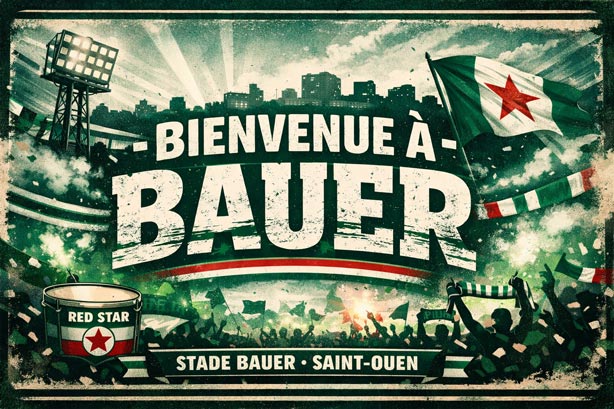
Stade Bauer is not merely a sports facility; it is the true living heart of Red Star FC, located at 92 rue du Docteur Bauer, Saint-Ouen. It is here that the first team plays its league matches, in a stadium that breathes popular football and history.
Nestled in the very center of Saint-Ouen, the stadium is surrounded by residential buildings—so much so that some residents can watch matches from their windows.
Access and practical information on matchdays
To reach Stade Bauer, supporters can choose from several transport options, benefiting from the excellent public transport network serving Saint-Ouen. Due to the dense urban environment, public transport is strongly recommended.
Main ways to access the stadium
| Mode of transport | Line / Route | Stop / Station | Distance from the stadium |
|---|---|---|---|
| Metro | Line 13 | Garibaldi or Mairie de Saint-Ouen | 10–12 min walk |
| Metro | Line 14 | Mairie de Saint-Ouen | 10–12 min walk |
| Metro | Line 4 | Porte de Clignancourt | 15–20 min walk |
| Bus | Line 166 | Michelet – Docteur Bauer | In front of the stadium |
| Bus | Line 255 | Michelet – Docteur Bauer | In front of the stadium |
| Bike | Vélib’ | Rue du Dr Bauer station | 50 meters |
Car access is generally discouraged on match nights due to heavy traffic in the neighborhood and the limited number of on-street parking spaces. For visitors coming from Paris or the suburbs, Metro Lines 13 and 14 remain the fastest and most reliable options, ensuring a travel time of around 30 minutes from central Paris (Châtelet or Saint-Lazare).
A stadium and a club steeped in history…
Opened in 1909 and formerly known as the Stade de Paris, the venue hosted football matches during the 1924 Olympic Games. After World War II, it was renamed in honor of Dr. Jean-Claude Bauer, a Jewish physician, communist militant, and resistance fighter, executed in 1942.
One of the stands is also named after Rino Della Negra, a former Red Star player and member of the Manouchian resistance group, executed by the Nazis in 1944. This symbolic choice reflects the club’s popular, committed, and antifascist identity, founded in 1897 by Jules Rimet, the creator of the first Football World Cup.
…and very recent renovation works
However, to meet the requirements of modern professional football, the stadium has been undergoing an ambitious renovation project launched in the early 2020s.
Beyond essential modernization, the goal is to increase the stadium’s total capacity to 10,000 seated spectators by 2026.
The objective is to preserve the historic soul of the venue while upgrading the infrastructure: VIP areas, European-standard locker rooms, and improved safety measures.
The Marville training center: preparing the future in Saint-Denis
While the historic heart beats at Bauer, Red Star’s sporting lungs are now located slightly further north, at the Parc des Sports de Marville, in La Courneuve and Saint-Denis. This is where the official training center of the professional team and the club’s Academy are based.
The choice of Marville reflects a drive toward professionalization initiated by club president Patrice Haddad. Located approximately 4 kilometers from Stade Bauer, this complex offers high-level facilities that the limited space in Saint-Ouen could not accommodate.
Facilities include:
- A building dedicated to the professional squad, featuring a gym, hydrotherapy area, and catering facilities.
- Regulation training pitches (including one with a hybrid grass surface) for youth and reserve teams.
- Administrative offices for the technical staff.
This move to Marville symbolizes Red Star’s ambition to develop its own talents within the department. The Academy, which brings together hundreds of registered players, will ultimately benefit from a direct synergy with the professional team.
Red Star FC: a club rooted in its territory and its history
Founded in 1897 by Jules Rimet, the future creator of the World Cup, the club embodies the values of humanism and popular education. Its location in Seine-Saint-Denis—often referred to as the “Red Suburbs” because of its political and working-class history—has shaped Red Star’s unique identity within French football.
Through the Red Star Lab (Article in French), a cultural and artistic structure integrated into the club, Red Star offers its members workshops in writing, photography, and theater. The Red Star is therefore not only a football club, but also a place of holistic education.
Red Star is the standard-bearer of Seine-Saint-Denis and Saint-Ouen, one of the poorest departments in France. It represents a form of popular football, deeply rooted in its history and territory, in contrast to a business-driven football disconnected from social realities.
Frequently asked questions
Is Red Star FC based in Paris?
Technically, Red Star is not located within Paris proper, but in the neighboring municipality of Saint-Ouen-sur-Seine (93). However, the club was indeed founded in Paris in 1897 before moving and settling permanently in Saint-Ouen in 1909. Red Star FC maintains a strong connection with the capital, as Stade Bauer is located just a few hundred meters from Porte de Clignancourt.
Why doesn’t Red Star play at the Stade de France in Saint-Denis?
Bien que le Stade de France soit situé à proximité immédiate, à Saint-Denis, il n’est pas le stade résident du Red Star pour des raisons de dimensionnement et d’identité. Avec ses 80 000 places, il est disproportionné pour les affluences moyennes du championnat de Ligue 2, et le club privilégie l’ambiance populaire et historique du Stade Bauer à Saint-Ouen. Néanmoins, le président Patrice Haddad n’exclut pas de jouer au Stade de France pour des matchs exceptionnels, comme un derby contre le Paris Saint-Germain si l’Étoile Rouge monte en Ligue 1.
Why is Red Star’s stadium called Bauer?
Jean-Claude Bauer was a physician, resistance fighter, and communist activist who was executed by the Nazis in 1942. The Saint-Ouen stadium, home of Red Star FC, bears his name in tribute to his commitment and sacrifice.
Is Red Star a communist club?
Red Star FC has never been a communist club. Its name, chosen in 1897 by Jules Rimet, comes from an ocean liner rather than from any ideology. While its working-class history and its ties to a historically ‘red’ city such as Saint-Ouen have shaped the image of a club engaged on the left, Red Star remains above all a club focused on anti-racism, tolerance, and closeness to its supporters, with no official political affiliation.”
Why is a stand at Red Star named after Rino Della Negra?
The Rino Della Negra stand at Stade Bauer honors the memory of an iconic Red Star player as well as a hero of the French Resistance. The son of Italian immigrants, Rino Della Negra grew up in Argenteuil. Spotted at a very young age for his footballing talent, he joined Red Star in 1942 while simultaneously engaging clandestinely with the FTP-MOI alongside Missak Manouchian. Sentenced to death at just 20 years old, he was executed by the Nazis at Mont-Valérien in 1944, leaving behind a powerful figure of courage and commitment.
Each year, the club and its supporters commemorate his memory: a memorial plaque was unveiled at the stadium in 2004, and the main stand now bears his name.
Johann Macq
Web writer passionate about football and history, I have specialized for several years in clubs from Paris and the Île-de-France region. I cover both the most well-known teams and those with a more understated prestige, sharing stories, anecdotes, and insights with fellow football enthusiasts.