



Key points
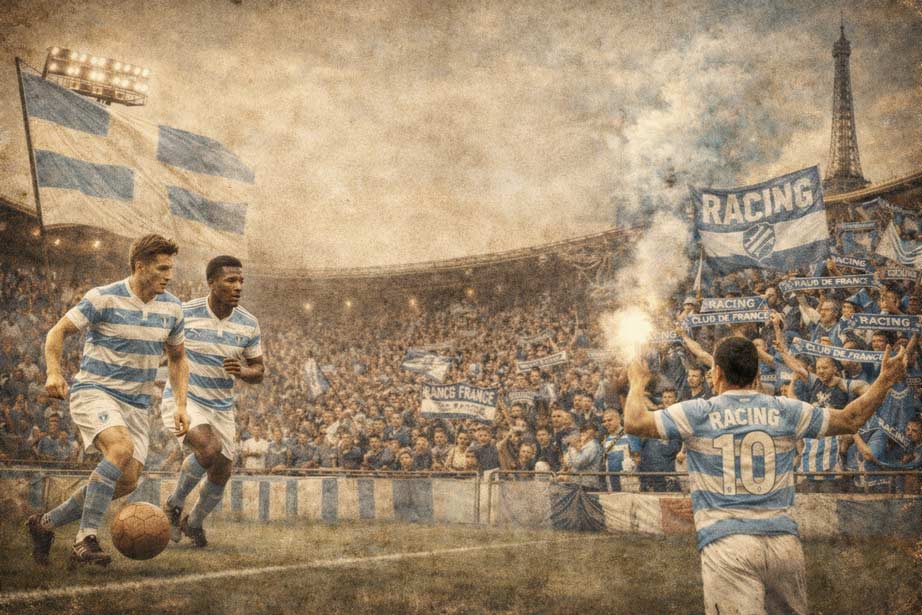
A legendary club with a prestigious past: Founded in 1882, a pioneer of French football, double championship–cup winner in 1936, Racing remains one of the emblematic names in French sport.
A turbulent and multifaceted identity: From Racing Club de France to Matra Racing and then Racing Paris, the club has changed names and leadership repeatedly.
A sleeping sports giant: Today in National 3, Racing remains a major institution in French football, its historical status contrasting sharply with recent sporting realities.
Revival driven by Patrick Norbert: Since 2018, the club has reclaimed its original name, historic logo, and a clearer direction, even if results remain inconsistent.
Sommaire
Some names in French football resonate like glorious relics, such as Red Star FC, for example. Names that carry with them a scent of history, elegance, and tradition. Among them, Racing Club de France, a multi-sport club founded in 1882 in Colombes, in the Paris region, holds a special place. Dominant in France during the 1940s, the football section of this originally multi-sport club later went through decades leaving a mark in history that sometimes leaves a bitter taste, and it changed names multiple times with each revival: Racing Club de France, Matra Racing, Racing Paris… So many lives, so many sometimes failed attempts to reclaim its natural place at the top of French football.
Even today, despite years of wandering and seasons spent away from the spotlight, some persistent supporters hold a firm belief: Racing deserves its place among the elite of French football.

A Historic Club, Multiple Identities
Racing Club de France is first and foremost a legend. A pioneering club, one of the first to structure football in France (alongside Red Star a little later), and one of the few to win the French championship and cup double as early as 1936, in an era when football was still being built.
But it is also a club that, in order to survive, had to reinvent itself many times. The famous Matra Racing, backed by industrialist Jean-Luc Lagardère in the 1980s, remains one of the most striking chapters—a symbol of a futuristic but unstable project.
After altering the club—changing its name and moving it to Parc des Princes, where it played before sparse crowds—and with results falling short (just one Coupe de France final lost to Montpellier in 1990), Lagardère disengaged. The club did not recover and fell back to amateur status, where it remains today.
A Fallen Giant… But Never Dead
That a club of this stature is playing in National 3—the fifth tier of French football—in 2025/2026 borders on the absurd.
Racing is not a neighborhood club in Hauts-de-Seine. It is a founding club. A club of development. A name that matters, a badge that carries weight. Purists know it: in the DNA of French football, Racing deserves a central role.
The contrast between this historical grandeur and recent sporting reality is striking. Since the 1990s, the senior team has stagnated, often lacking consistency, struggling to present a coherent project. But this apparent dormancy is only a façade; behind modest results lies a deeper, more promising movement since the arrival of Patrick Norbert, new owner and president since 2018.
The Norbert Family at the Helm: A Fresh Start?
Since Patrick Norbert became president on February 13, 2018, Racing has clearly changed course. A former actor turned head of Capitol Films and then president of SCO Angers between 2003 and 2006, Norbert did not arrive from nowhere. Upon taking over, he tackled one of the club’s most sensitive symbols: its identity.
Under his leadership, Racing Club de France Football Colombes 92—yet another name in a long series—returned to simply Racing Club de France, or Racing CFF, reconnecting with its original designation. Even better, the club reclaimed its historic logo from the multi-sport era, a true emblem of a time when Racing shone across disciplines.
A thoughtful, deliberate choice, which Norbert explained three years ago:
Returning to its origins: a bold, almost foundational gesture. But while the symbolism is powerful, sporting reality remains more mixed.
Despite the enthusiasm of renewal, the first team has experienced ups and downs. Racing narrowly missed promotion to National 1 in 2022–2023, losing out to Rouen—a result that coach Guillaume Norbert publicly commented on, citing possible irregularities, as reported by the French newspaper Le Parisien. The story then accelerated: the following season, the club was relegated to National 3, despite a strong Coupe de France run. A sudden brake. A step back? Or simply another stage in a long reconstruction process?
The Thorny Issue of Stade Yves-du-Manoir
Is the renovation of Stade Yves-du-Manoir in Colombes—the historic home of Racing—finally underway? This iconic stadium, the only one in France to have hosted the Olympics twice, remains a powerful symbol, but a symbol needs a modern stage to become a driving force again.
Since the departure of the Racing 92 rugby team and the Olympic renovations, Racing CFF could have hoped to reclaim this legendary venue. Yet no provision for football was included in the Olympic project, angering many supporters.
Forced to play outside Colombes for several years, the club remains uncertain about where the senior team will play in the future. A modernization project is now being led by Jacky Lorenzetti, businessman and owner of Racing 92.
Could synergy with the rugby club be in the works? Racing fans want to believe it. In a 2018 interview with Le Parisien, the Racing CFF president said:
Youth Development: A Quiet but Powerful Engine
This may be where Racing has been most surprising in recent years. Lacking senior success, the club’s youth teams have consistently performed, accumulating results and promotions. The U17 and U19 squads are participating in national championships this year.
This is no coincidence. The club’s culture has always emphasized athletic education, mentorship, and progression. The work done behind the scenes by coaches, development managers, and technical teams is recognized across Île-de-France.
The next challenge is to translate this momentum to the senior squad.
Is Racing Ready to Rise Again? A Revival French Football Awaits
Racing Club de France is a monument of French football. A damaged monument, yes, but not destroyed. Today, everything suggests its foundations are vibrating once more. The machine is restarting. The giant is awakening!
There is still a long way to go, but the first step of ascent seems, hopefully, finally underway. Racing does not belong in National 3. It belongs to the top tier.
A story true to what it is: a historic club… eager to return among the greats.
FAQ
Where does Racing Club de France play?
Historically, Racing Club de France Football plays in Colombes at Stade Yves-du-Manoir, its emblematic home. After Racing 92 left and Olympic renovations, Racing CFF could have hoped to return to this iconic ground. Previously, most matches were held on an adjacent pitch, now demolished for the Olympics. The Olympic project left no room for football; the former Lucien Choine field is gone, and the main stadium used during the Games remains unused. The first team has played outside Colombes for several seasons, including in Poissy for 2025/2026.
Is Racing Club de France Football still part of a multi-sport club?
No. Racing CFF was once a section of Racing Club de France, a multi-sport club founded in 1882, encompassing athletics, swimming, field hockey, and more. The football section officially separated from the multi-sport club in 1991.
What is the connection between Racing Club de France and Racing 92?
Racing 92 (rugby) historically comes from the same multi-sport structure as Racing Club de France. They share a common past and similar culture but are now independent, with distinct professional and financial trajectories.
What is the link between Racing CFF and Racing Club in Argentina?
Racing Club (Avellaneda) took its name and part of its identity from Racing Club de France. In 1903, during the merger that created the Argentine club, founding member Germán Vidaillac proposed the name after discovering it in a magazine detailing Racing Club de France’s exploits. The “azul y blanco” colors—sky blue and French white—also reflect this historical connection.
Why is Stade Yves-du-Manoir unique in France?
It is the only French stadium to have hosted the Olympics twice (1924 and 2024). It has hosted historic events: Coupe de France finals, international matches, rugby competitions, concerts, etc. It was long the nerve center of French sport before Parc des Princes and Stade de France were built.
Has Racing Club de France football ever merged with Paris FC?
Yes. In 1982, Jean-Luc Lagardère bought Paris FC, then in the second division, hoping Racing Club de Paris (= Racing CFF), then amateur, would merge. He renamed it Racing Paris 1 and reinstated Racing’s iconic sky blue and white colors. The merger was finalized, Racing CFF disappeared, and Paris FC had to restart from the fifth tier.
Why is the penguin the club mascot?
Since the mid-1930s, the penguin has been the nickname of Racing Club de France’s football section, likely in rivalry with the rugby section, which could use its arms. The animal later appeared in person during key events: for example, in May 1939, a real penguin was brought from Vincennes Zoo to do a lap with the players during a Colombes final, reinforcing the nickname among fans and media.