



Key Takeaways
- Founded in 1968 and renamed in 2020, Paris 13 Atletico aims to assert its identity in Paris’s 13th arrondissement.
- The club has nearly 1,500 registered players and plays a major social role for local youth.
- Its limited facilities push it to target the Stade Charléty for certain matches.
Table of Contents
LEGENDISSIME, a website specializing in Paris and Île-de-France football, is shining a spotlight on lesser-known clubs such as Paris 13 Atletico. Between PSG and Paris FC, already firmly established, the club from the 13th arrondissement is striving to carve out its place in an ultra-competitive Parisian football landscape. Its journey, marked by several name and stadium changes, illustrates the challenges it faces to exist and grow in the capital.
From Its Origins to Sporting Rise and Name Changes
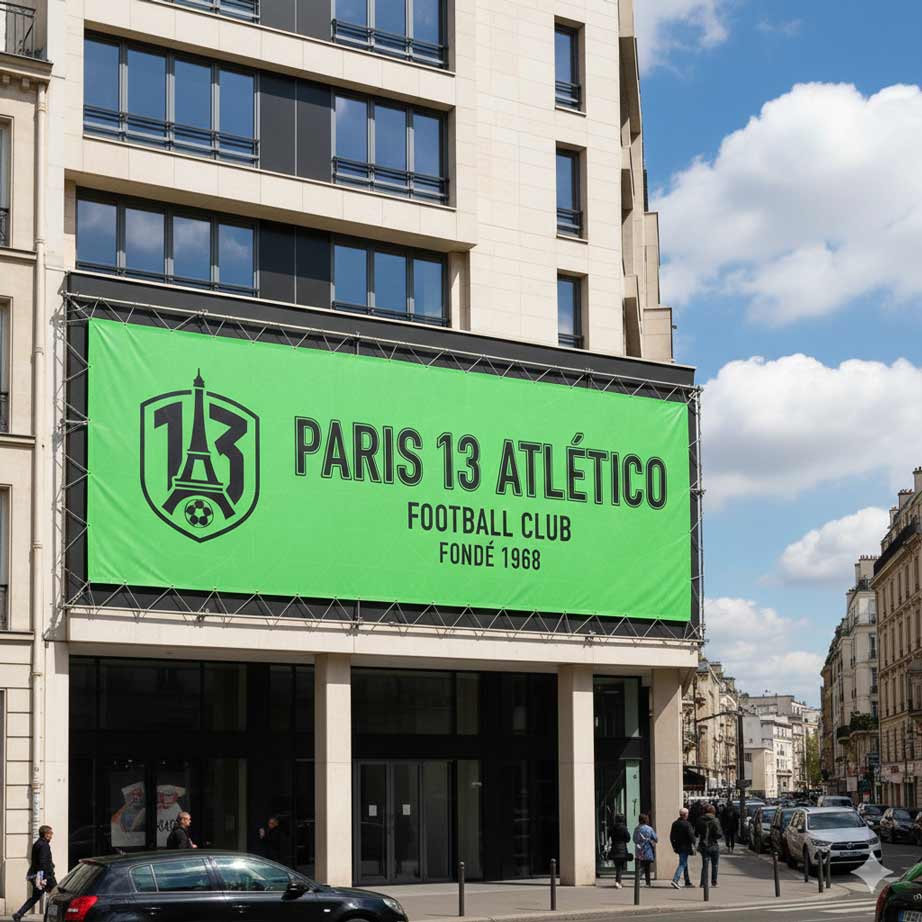
The entity now known as Paris 13 Atletico traces its roots back to 1968. Originally named FC Gobelins, the club was deeply rooted in the historic Gobelins neighborhood of the 13th arrondissement.
A decisive turning point came in 2012 with the merger between FC Gobelins and Stade Olympique de Paris, creating FC Gobelins Paris 13.
In just a few seasons, the club climbed the ranks from Regional level (R1) to National 2, and then to the National championship (France’s third division).
The 2020 rebranding to Paris 13 Atletico followed a dual objective: reinforcing its territorial identity within the 13th arrondissement and modernizing its image to attract partners and media attention.
A Small Club in Media Exposure, but a Paris Giant in Registered Players
While media attention often focuses on elite clubs like PSG and Paris FC, Paris 13 Atletico’s real strength lies in its exceptional grassroots base.
A Unique Structure, Team Diversity, and Social Role
Paris 13 Atletico stands out through a rarely highlighted but telling indicator: the number of registered players. Frequently topping the Île-de-France rankings, the club gathers nearly 1,500 members (Source: the website of the French Football Federation, in French) each season, making it the second-largest club in France in this respect.
Beyond the pitch, the club plays a major social role in southeast Paris. It acts as a powerful force for social cohesion, welcoming young people from diverse backgrounds and providing a structured environment. This educational dimension lies at the heart of its community-driven project, making the club a true hub of local life in the 13th arrondissement.
Infrastructure Challenges: A Major Obstacle to Development
Paris 13 Atletico’s growth is hindered by a structural issue: the mismatch between its sporting ambitions and its current facilities.
The club’s historic ground, Stade Boutroux (recently renamed Stade Pelé), located at Porte d’Ivry, features a synthetic pitch and limited seating capacity—facilities considered inadequate for National league standards.
In this context, Stade Charléty represents a strategic opportunity. Long occupied by Paris FC, the stadium has become partially available since the club moved to Stade Jean-Bouin. According to the French newspaper Le Parisien, Paris 13 Atletico has officially requested to host more matches there, seeing Charléty as far better suited to National standards in terms of capacity and pitch quality.
Beyond sporting considerations, this move would also serve as a crucial lever to strengthen local anchoring and enhance the club’s medium-term credibility.
The First Team in Search of Stability
With limited financial resources, the recruitment strategy prioritizes smart decision-making: combining players seeking redemption after experiences in Ligue 2 or National (third division) with promising talents from the Île-de-France talent pool and youth academy system.
Players with backgrounds in professional academies provide essential technical experience. The clear objective is survival in the National league as smoothly as possible, avoiding the “yo-yo” effect back down to National 2 (Fourth tier), as experienced in recent seasons.
Conclusion: The Future of Paris 13 Atletico
Paris 13 Atletico currently navigates between promise and constraint. On the sporting front, the club has proven its worth by reaching the National and aims to establish itself there sustainably.
Its future will depend on its ability to transform its exceptional player base into a genuine economic and popular driving force, while convincing public authorities to support infrastructure development matching its ambitions.
The lingering question remains: in the medium term, can Paris 13 Atletico rise high enough to one day challenge PSG or Paris FC on the Parisian stage?
Frequently Asked Questions
What is Paris 13 Atletico’s budget?
For the 2025/2026 season in National (third division), the club’s budget is around €2.2 million. This remains modest compared to division heavyweights such as AS Nancy, Dijon, and Sochaux, making Paris 13 Atletico the second-lowest budget in the league.
What is the club’s history?
Founded in 1968 as FC Gobelins, the club merged in 2012 with Stade Olympique de Paris to form FC Gobelins Paris 13. It then experienced a spectacular rise from regional divisions to the national level, adopting the name Paris 13 Atletico in 2020 to better reflect its territory and ambitions.
Where does the club play?
The team plays at Stade Pelé (formerly Stade Boutroux), located on Avenue de la Porte d’Ivry in the 13th arrondissement. The stadium features a synthetic pitch and modest capacity. For certain high-profile matches or temporary approvals, the club hopes to increasingly use Stade Charléty.
Why is the club called “Atletico”?
The term “Atletico,” adopted in 2020, does not pay tribute to Atlético Madrid. Instead, it derives from the athletic roots of sport and reflects a desire for modernization. The internationally sounding name marks a break from the more locally perceived “Gobelins.”
What is the club’s record?
Paris 13 Atletico’s honors list remains relatively modest. Its main achievement is winning the National 2 (Group B) French championship title in the 2021–2022 season, followed by another promotion in 2023–2024 after finishing first in its group. The club has also collected several regional titles throughout its rise from district-level competitions.
Which notable players have passed through the club?
With its strong youth base, the club has developed several players who later turned professional. Additionally, promising Île-de-France talents such as Karl Toko Ekambi and Soualiho Meïté have played on the club’s pitches or developed in the 13th arrondissement during their formative years.