


Summary
Why supporter chants are the soul of football
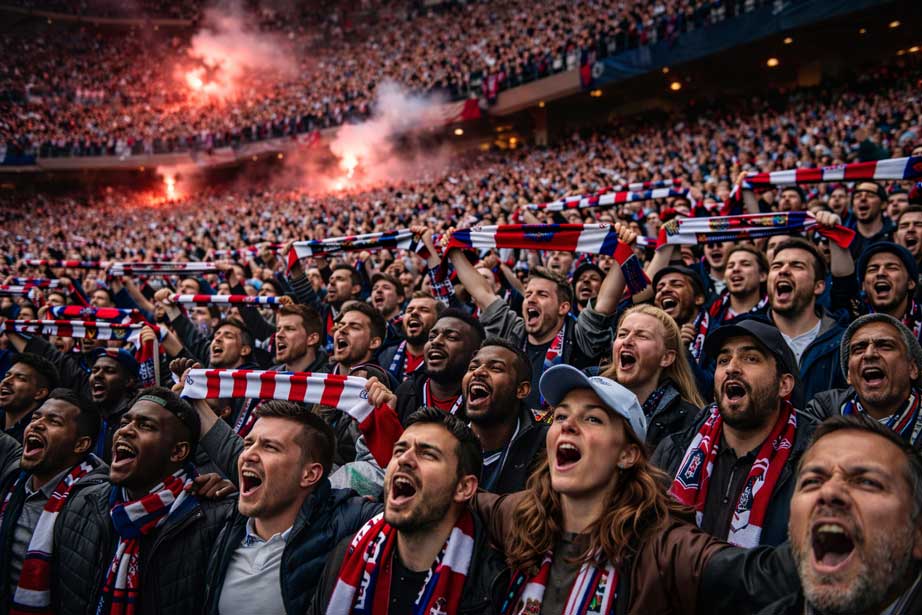
Football without its supporters would lose its essence. With them, football becomes a culture and a vehicle of social identity. Supporter chants form the heart of the stadium experience, acting as a performance catalyst for players and turning a sports arena into a fortress. Sociologically, chanting unites thousands of individuals into a powerful vocal entity: the “twelfth man.”
The acoustic impact is striking. At Anfield or Stade Bollaert-Delelis, volumes exceed 100 decibels, creating tangible pressure on the opposition. These anthems tell the story of the club, its glories, and its regional roots. Whether claiming regional identity in Nice (“Nissa la Bella”) or intimidating opponents like in Marseille, chanting is the ultimate expression of passion. This unique atmosphere makes football the world’s most popular sport.
Here is LEGENDISSIME’s Top 10 best supporter chants. A completely subjective ranking to take with a pinch of salt.
1. RC Lens: Les Corons
Origin and history of the chant
Les Corons is the unofficial anthem of a northern French region shaped by the mining industry. Written by Pierre Bachelet in 1982, this poignant song was adopted by the Stade Bollaert-Delelis crowd in the early 2000s. Unlike warlike chants, Les Corons pays tribute to the suffering and solidarity of coal miners, ancestors of many stadium supporters.
Lyrics and stadium atmosphere
The ritual is unchanging: at halftime, the blood-and-gold scarves rise, and 38,000 people sing a cappella. The lines ‘Au Nord, c’était les corons / La terre c’était le charbon…’ (which could be translated as “In the North, there were the mining towns / The land was coal”) resonate with intense emotion. The atmosphere is solemn and brotherly—a moment of cultural identity where football gives way to the social history of the mining basin.
2. PSG: “Tous ensemble on chantera”
Origin and history of the chant
While Paris Saint-Germain has a varied repertoire, Tous ensemble on chantera (=Together, we will sing) is a pillar of the ultras’ identity at Parc des Princes. Inspired by an Italian singer Noémie, the melody first circulated in minor Italian clubs before being definitively adopted by the Parisian kop in 2016, with some adaptations.
Lyrics and stadium atmosphere
When Parc des Princes sings this anthem, the concrete structure vibrates. A unifying chant, it also recalls the Leproux years, when the ultras were banned from the stadium. The lyrics highlight enduring devotion: “After so many years, of struggles and battles…” where attachment to the club survived despite exile from the stands.
3. Olympique de Marseille: “Aux armes”
Origin and history of the chant
Emblematic of the Virage Sud, Aux armes! (=Grab your weapons) embodies Marseille supporters’ pride. Inspired by the French national anthem, it borrows the call “Aux armes!” as a rallying cry in the stands. Perhaps the most heard chant at the Vélodrome, it unites both curves in a warlike message. Its collective nature creates a vocal and physical momentum that unites fans.
Lyrics and stadium atmosphere
At the Vélodrome, the capo starts the chant, and the curves respond in turn, thousands of fans echoing “Aux armes!” The effect is spectacular: the stadium vibrates, especially after a goal.
4. Liverpool: “You’ll Never Walk Alone“
Origin and history of the chant
Arguably the most famous football chant. From the 1945 musical Carousel, it was covered in 1963 by Gerry and the Pacemakers and adopted by the Spion Kop at Anfield. YNWA became sacred after the 1989 Hillsborough disaster, symbolizing eternal resilience and solidarity between club and fans.
Lyrics and stadium atmosphere
Singing YNWA at Anfield is mystical. Music stops, leaving 54,000 supporters’ voices to carry the melody. Lyrics: “Walk on, walk on, with hope in your heart, and you’ll never walk alone”. The emotional intensity often gives opposing players goosebumps. Red scarves form a visual wall, sealing absolute loyalty.
5. Panathinaikos: “Horto Magiko”
Origin and history of the chant
Horto Magiko (The Magic Grass) is an intense chant of Panathinaikos ultras, Gate 13. Emerging in the 2000s, it uses a fast melody to describe supporters’ addiction to their club, likened to a drug, reflecting the “ultra” mentality of total devotion to the team.
Lyrics and stadium atmosphere
The atmosphere is organized chaos. The rhythm builds, lyrics are delivered rapidly with dynamic gestures—it’s madness in the stadium!
6. Red Star : “Le Red Star, c’est seulement à Bauer”
Origin and history of the chant
Founded by Jules Rimet, Red Star FC embodies Saint-Ouen’s working-class culture. This chant emerged to protect the club’s soul from relocation projects. The Red Star Bauer collective used it to reaffirm attachment to Stade Bauer, resisting football commercialization.
Lyrics and stadium atmosphere
Supporters chant: “Red Star, only at Bauer, the guardian of our history, engraved in our hearts”, uniting fans in defense of their territory and memory.
P.S. : Nous n’avons pas trouvé de vidéos de qualité, mais voici une version alternative du chant :
7. OGC Nice : “Nissa la Bella”
The anthem of Nice, sung in Nissard (a regional Occitan dialect), symbolizes attachment to the city. Sung at the start of each match at Allianz Riviera, it instills local pride and stadium cohesion. A true identity symbol celebrating Nice’s beauty and history.
8. Celtic Glasgow: “Just Can’t Get Enoug”
Originally, ‘Just Can’t Get Enough’ is a song by the band Depeche Mode, composed by Vince Clarke and included on the album Speak and Spell.
The track later gained unexpected popularity in British football stadiums. The first to adopt it were Celtic Glasgow supporters in 2009, quickly followed by Burnley FC fans the same year, and then by the Bolton Wanderers in early 2011. Around the same time, Liverpool fans also took an interest. Unlike the Celtic supporters, who keep the original lyrics, Liverpool fans adapted them to create an anthem dedicated to their Uruguayan striker, Luis Suárez.
9. Olympique Lyonnais: “Qui ne saute pas n’est pas Lyonnais”
Likely originating from Italy, first used by OM supporters, then adopted by Lyon’s Bad Gones. Sung at Groupama Stadium, thousands jump together shouting: “And who doesn’t jump isn’t Lyonnais!”
10. Bonus – AS Saint-Étienne: « Popolopopo, allez Sainté ! »
At Geoffroy-Guichard (Le Chaudron), Magic Fans and Green Angels create a unique atmosphere. Without words, the kops echo each other in unison.
Conclusion on the best supporter anthems
This ranking is indicative and subjective. Many lists exist online, each with its own perspective. Parisian clubs like PSG and Red Star are highlighted here. Ultimately, the best chant is the one that makes your heart vibrate.