


Key Takeaways:
A club created to bring top-level football back to Paris: founded in 1969 at the initiative of the FFF, Paris FC was born to fill the void left by the disappearance of professional Parisian clubs in the 1960s.
A history closely linked to PSG: the merger with Stade Saint-Germanois in 1970 gave rise to PSG, before a rapid split that saw PSG establish itself permanently while Paris FC fell into the shadows and lost its professional status.
Patient rebuilding under Pierre Ferracci: his arrival brought financial stability, club structuring, a focus on youth development, and a popular identity, allowing PFC to re-establish itself in professional football.
Success first coming through women’s football: the integration of FCF Juvisy in 2017 immediately propelled Paris FC Women to the top, with regular appearances in Ligue 1 and the Champions League, increasing the club’s visibility.
A step up with LVMH and Red Bull: the 2024 takeover marked a historic turning point, with promotion to Ligue 1, European ambitions, a new stadium (Jean Bouin), and a goal to build a true second hub of Parisian football.
Table of Contents
LEGENDISSIME, a web media specialized in football news in Paris and Île-de-France, focuses today on Paris FC, the other emblematic club of the capital alongside PSG.
Let’s look at the story of this club, from its foundation to the notable episode of its merger and subsequent separation from Paris Saint-Germain, which few Parisians actually know about. We will then revisit its long period in the shadows before analyzing its current organization, squad, and new prospects, especially related to the arrival of new investors.
The roots of Paris FC: from its foundation to the PSG episode
Together with PSG, PFC also once embodied the ambition to provide Paris with a top football team. Let’s explore this in detail.
The birth of Paris FC and its first ambitions
The club was born from an initiative by the French Football Federation to re-establish a professional club in Paris, following the gradual abandonment of professional status by three iconic Parisian clubs in the 1960s: Cercle Athlétique de Paris in 1963, Racing Club de France in 1966, and Stade Français in 1968.
Paris Football Club was founded in 1969 with a clear vision: to create a top professional club in Paris. This initiative addressed a gap in Parisian sport.
The merger-split with Paris Saint-Germain: a complex legacy
Denied direct access to the top tier due to a lack of a federation waiver, Paris FC found itself in a sporting dead-end at the time. To quickly compete at the highest level, the young Parisian club had to align with a structure already participating in national championships.
This solution took shape in 1970 with the rapprochement with Stade Saint-Germanois, then in the third division. From this strategic alliance was born Paris Saint-Germain Football Club, a name destined to leave a lasting mark on French football history.
Promoted to Division 1 as early as 1972, the club soon experienced internal division. Part of the management wanted to remove the “Saint-Germain” mention, notably to secure financial support from the City of Paris, as the team was preparing to move into the newly rebuilt Parc des Princes. This rupture led to a split: the professional structure was transferred to a new Paris Football Club, which merged shortly afterward with Cercle Athlétique de Montreuil, bringing its amateur teams and youth talent pool. Meanwhile, Paris Saint-Germain FC continued in Division 3, at the level of its reserve team.
This arrangement, intended to maintain a Parisian club at the top of French football, backfired on its initiators. Within two seasons, Paris Saint-Germain FC returned to Division 1 in 1974, established itself at Parc des Princes, and became the only Parisian club with national prominence. In contrast, Paris FC was relegated to Division 2 the same year and struggled to build a fan base, cementing the shift in power between the two entities.
Worse, unlike PSG, which reached the top, Paris FC continued to slide down the French football hierarchy and lost its professional status for many years.
The impetus of Pierre Ferracci
Pierre Ferracci’s arrival at the helm of Paris FC marked a decisive turning point in the history of this Parisian club. His deep commitment and long-term vision were the pillars of the club’s gradual structuring, taking it out of anonymity and instilling new ambition.
A journey first full of ups and downs
Under Pierre Ferracci, Paris FC initially experienced a sporting trajectory marked by highs and lows. The team often navigated between Ligue 2 and the National league, fighting to establish itself in the higher divisions. Every match was a challenge for this Parisian team, which sought to consolidate its place in the French football landscape. Despite fluctuating results, with promotions sometimes followed by relegations, Ferracci’s perseverance strengthened the foundations of Paris FC, laying the groundwork for a more solid structure.
This visionary leader brought the financial stability the organization desperately needed. His goal was clear: to create a sustainable structure anchored in its Parisian territory. Ferracci focused on youth development and built a loyal fanbase, notably through his free-ticket initiative. This strategy allowed Paris FC to cultivate a popular, community-centered image. PFC was no longer just a football team but a club capable of mobilizing devoted supporters for years to come.
The women lead the way: the absorption of Juvisy women by Paris FC
Before the men’s first team reached the top division, it was the PFC women who set the example. While the men’s team pursued promotion to Ligue 1, women’s football at Paris FC took a decisive turn.
The absorption of Football Féminin Juvisy Essonne (original source in french) in 2017 marked a major milestone. This strategic integration, led by Pierre Ferracci, immediately provided the club with a competitive women’s section, now established in the elite of French football and having competed twice in the Champions League.
Moreover, the women’s team has consistently been among the top three in the league for several seasons, fostering a budding rivalry with Paris Saint-Germain.
This choice broadened opportunities for sporting success and diversified the club’s news coverage, while strengthening its visibility and media appeal.
[COMMUNIQUE]
— Paris FC Féminines (@PFC_feminines) July 6, 2017
Le FCF Juvisy Essonne et le Paris FC ne font plus qu'un !
➡️ https://t.co/2HIPDI3dBa pic.twitter.com/03V22BoP2M
The arrival of LVMH: a new chapter for Paris FC?
In 2024, a thunderbolt: LVMH and Red Bull announce the purchase of Paris FC!
The arrival of LVMH & Red Bull completely changes the game for Paris FC. This historic acquisition propels the Parisian team into a new dimension, with ambitions far beyond mere survival in professional football. A major project emerges, driven by the resources and expertise of the French luxury giant.
A strategic investment for development
LVMH did not stop at a simple check. The group’s investment brings unprecedented financial stability to Paris FC, finally allowing it to compete with other French clubs. This capital injection transforms infrastructure, modernizes the training center (original source in french), and opens the door to recruiting promising talent.
The long-term vision goes beyond finances. With Red Bull, LVMH leverages its global network for the team, creating partnership and development opportunities few clubs can hope for. For a Paris FC long confined to the lower divisions, this is a spectacular leap toward the heights of French football.
Finally, a Parisian derby in Ligue 1
Gone are the days when the team struggled for survival. As of 2024, with LVMH as a partner and finishing second in Ligue 2, Paris FC reaches the pinnacle: a place in the French top flight.
But Paris FC now has to establish itself there to aim higher, including in European competitions. Recruitment intensifies, and the coaching staff is strengthened.
From Stade Charléty to Jean Bouin: building a fanbase
Winning over and retaining a Parisian audience already loyal to PSG is a colossal challenge.
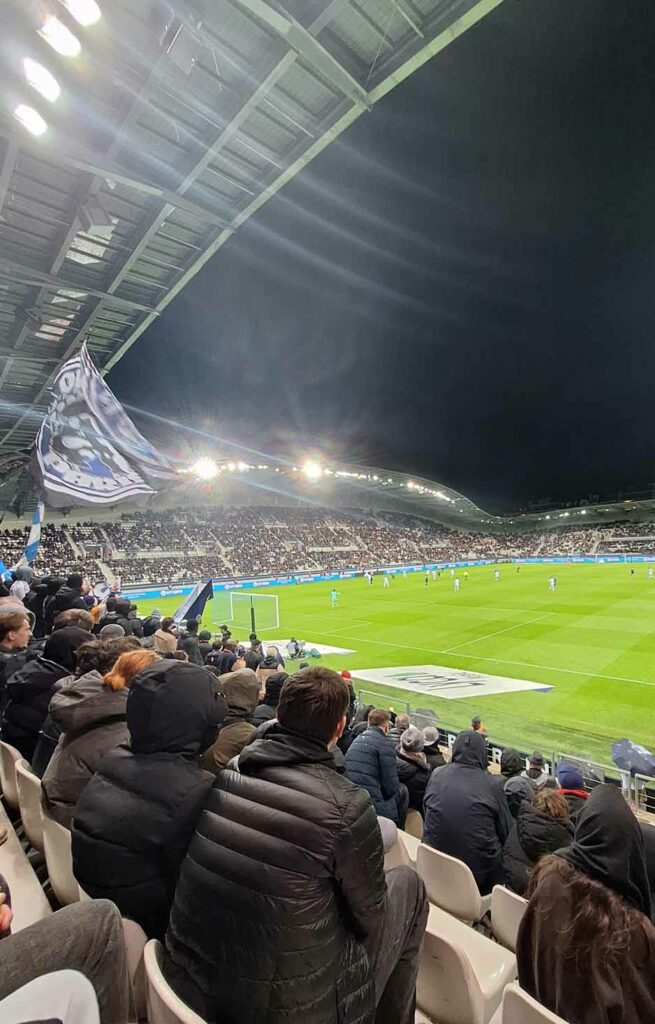
Since promotion to Ligue 1, enthusiasm around Paris FC has grown. The stands at Stade Jean Bouin (Paris FC no longer plays at Stade Charléty since promotion) welcome increasing numbers of passionate fans, but potential remains enormous in a capital already home to a football giant.
Early signs are encouraging: stands are gradually filling up at each match. Stade Jean Bouin offers a modern setting and increased visibility, essential ingredients to forge Paris FC’s unique identity and build a passionate supporter community.
Creating a strong identity becomes a priority. Matchday experience improves, community initiatives multiply, and LVMH & Red Bull contribute marketing expertise to reach new audiences.
Conclusion: a story to write with LVMH
Paris FC has carved a unique path, from its turbulent beginnings and separation from PSG to its gradual transformation into a solid organization. Pierre Ferracci laid the necessary foundations, particularly with the successful integration of the women’s team, which led the way.
Today, the arrival of LVMH opens a decisive chapter, giving Paris FC the resources to realize its sporting ambitions and expand its influence. This strategic partnership sets the team on a trajectory of new challenges, confirming that Paris FC is actively building its future in French football.
Frequently Asked Questions
Who owns Paris FC?
The Arnaud family with LVMH holds the majority of Paris FC since its major investment in 2024. This acquisition radically transforms the club’s financial capacity and redefines its sporting ambitions. The main goal is to establish Paris FC in Ligue 1 while restructuring its identity within the French football landscape. Current investments focus on strengthening the squad and modernizing infrastructure (the training center is set to be expanded).
Where does Paris FC train?
Paris FC trains in Orly, where its training center is located. Additionally, the training center will be expanded to support the club’s sporting and structural development.
Which stadium does Paris FC play in?
While Stade Charléty was long Paris FC’s main home ground, the situation changed with the club’s promotion to the top flight. Paris FC now plays at Stade Jean Bouin, which it shares with rugby club Stade Français, the stadium’s historic resident. Charléty, with its athletics track, did not fully meet the standards of a football-dedicated stadium, while Jean Bouin offers a modern setting better suited to top-level requirements.
Who is Paris FC’s biggest rival?
Paris FC’s main rival is not Paris Saint-Germain, contrary to what geographic proximity between Stade Jean Bouin and Parc des Princes might suggest. Historically and culturally, the two clubs operate in different spheres, and Antoine Arnaud, a long-time PSG supporter, has often expressed his desire to maintain cordial relations between the two entities.
The rivalry with Red Star truly took root in 2014, during clashes between supporters, as the two Île-de-France clubs frequently faced each other in French lower divisions, in Ligue 2 and National. These encounters established Red Star as Paris FC’s historical rival.
Which other clubs has Paris FC merged with?
Paris FC has experienced several important mergers in its history. In 1970, denied direct access to the top tier, the club merged with Stade Saint-Germanois, then in the third division, to create Paris Saint-Germain FC, allowing the young club to quickly rise in national championships. Later, in 1982, under Jean-Luc Lagardère’s initiative, Paris FC, then in the second division, merged with Racing Club de Paris (Racing CFF) to form Racing Paris 1, adopting Racing’s sky blue and white colors, while Racing CFF disappeared and Paris FC had to restart from the fifth national level.
What is Paris FC’s record?
Paris FC’s men’s team has never won a major title in French professional football. The club has long oscillated between lower divisions, without establishing itself in the top tier. Its record therefore remains devoid of national trophies.
However, the alliance with FCF Juvisy Essonne has deeply marked the club’s history, transferring the legacy and record of an emblematic women’s team in French football, with 6 French Championship titles and 2 French Cups to its name.

Johann Macq
Web writer passionate about football and history, I have specialized for several years in clubs from Paris and the Île-de-France region. I cover both the most well-known teams and those with a more understated prestige, sharing stories, anecdotes, and insights with fellow football enthusiasts.