


Key Points
Visibility and Influence: Owning a club allows billionaires to enhance their image, brand, and soft power on a global scale.
Strategic Investment: Clubs provide diversified revenue streams and access to exclusive business networks, while also representing valuable assets.
Personal Motivations: Passion for football, attachment to their hometown, and social prestige can be genuine drivers for billionaires.
Table of Contents
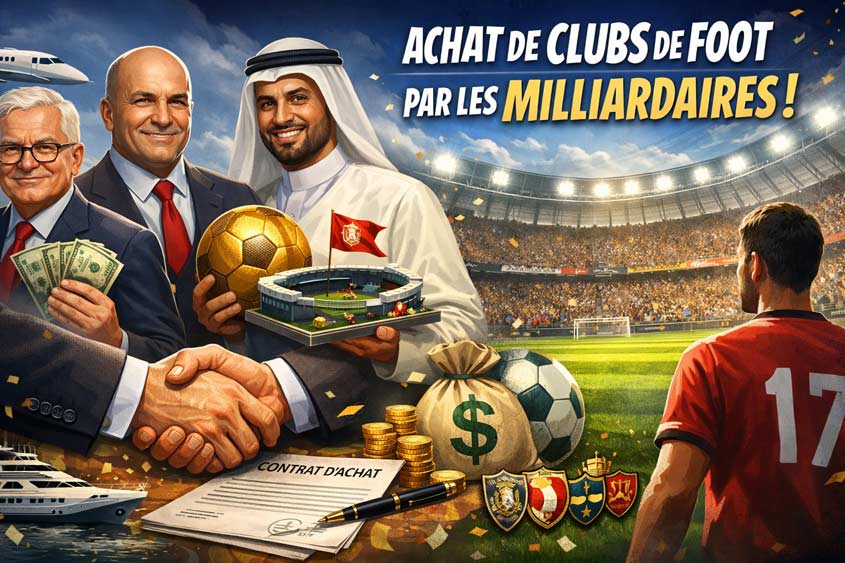
Recent news highlights an increasingly common phenomenon: the acquisition of Paris FC by the Arnault family (LVMH) or Xavier Niel’s investment in Créteil. It’s clear that football attracts the wealthiest fortunes. But why do these powerful figures pour millions into such a volatile sector? LEGENDISSIME breaks it down.
Football, a Powerful Lever of Soft Power and Influence
Football is far more than simple entertainment.
Professional football has established itself as an exceptionally effective communication tool for dominant capitalist actors because of its ability to capture a global audience, mobilize strong emotions, and structure widely shared collective narratives.
For a billionaire, owning a club offers immediate visibility and international legitimacy—a formidable tool of soft power to polish an image or promote a brand.
As the quintessential popular sport, football provides continuous positive exposure for wealthy individuals, multinational corporations, and investing states, associating their image with values of success, performance, and prestige. The spectacle of record transfers, exorbitant salaries, and billionaire-owned clubs helps normalize extreme economic inequalities, integrating them into the entertainment as ordinary elements of the game.
Although often presented as consensual and largely depoliticized entertainment, football in the era of millionaire players primarily serves to divert attention from social, economic, or geopolitical controversies while subtly but effectively reinforcing the logics of competition, hierarchy, and domination inherent to contemporary capitalism.
International Reach and Brand Image
Using football as a showcase is nothing new. In France, Jean-Luc Lagardère was a pioneer in the 1980s, transforming Racing Club de Paris into Matra Racing. He sought to link his industrial group’s name with the team, creating synergy between sporting and technological performance. This model of affixing a company name to a club became a blueprint.
Today, this logic has reached new heights. When Ineos and Jim Ratcliffe invest in sport (owning OGC Nice, holding a stake in a Formula 1 team, and owning a cycling team participating in the Tour de France, etc.), the goal is clear: leverage the resonance of these competitions to expose the brand to millions of viewers. The club or sporting event becomes a living advertising medium, benefiting from its emotional capital and passionate fan base.
Business Networks and Strategic Opportunities
European stadium VIP boxes and elite business lounges? Owning a club provides exclusive access to political decision-makers and business leaders.
For a foreign investor, acquiring an iconic club in France or the Premier League is a strategic gateway to develop other ventures. It’s a top-tier commercial facilitator. It’s no secret: Champions League nights often see infrastructure deals and strategic partnerships negotiated behind the scenes.
Here, the return on investment is measured in collateral opportunities generated by owner status—similar to owning a media outlet (Xavier Niel owns Le Monde).
Between Passion and Prestige: Personal Motivations of Owners
While economic reasons are often cited, the psychological and personal dimension remains crucial. Ultra-wealthy individuals are driven by deep emotions or a need for recognition. Football provides the adrenaline of competition and the adulation of crowds—experiences money alone cannot buy.
Love of the Game and Local Roots
The “local patron” argument frequently appears in statements. Xavier Niel exemplifies this with his investment in US Créteil-Lusitanos, expressing a desire to invest in the city where he grew up—a gesture framed as a genuine return to his roots.
Is this truly the main reason? This narrative serves as a powerful communication tool humanizing the billionaire. Yet the entrepreneurial logic persists in the background. Supporting the club of one’s childhood enhances the image of a “patriotic industrial leader”—strategic philanthropy where emotion reinforces lasting local or national influence.
As Henri Philippe, author of Creating Value in Football, notes:
Social Status and the Quest for Recognition
Owning a club confers unique social status and visibility that traditional business cannot guarantee. For some oligarchs, it accelerates fame dramatically.
Being the president lifting the trophy offers public validation and a place in sports history. For some, it is a quest for symbolic immortality, a way to assert power through their players’ performance. In such cases, the team becomes the ultimate toy for someone who already has everything: an army of modern gladiators fighting for their colors.
However, this view is reductive. Some owners are also engaged in collective projects or driven by genuine passion for the sport.
Economic Dimension: A Strategic and Potentially Lucrative Investment
Football has become a genuine asset class attracting major investment funds (private equity). Red Star has already experienced this with 777 Partners. The financial logic has shifted toward asset valuation rather than immediate profitability.
Revenue Models and Asset Growth
Making money from the annual operation of a club is rare in football. Most European clubs operate at a loss. Astronomical costs, such as the salaries of stars like Mbappé or Neymar, often consume all revenue.
Still, owners attempt to diversify sources: global merchandising, year-round stadium utilization (best if you own the stadium) for various events. However, the balance remains precarious. Player trading is unpredictable and risky. Immediate profit is rarely the main driver behind acquisitions.
Potential for Appreciation and Resale
The real gain lies in the spectacular capital appreciation at resale. Franchise values have skyrocketed in recent decades. The scarcity of “premium” clubs (e.g., Real Madrid or PSG) drives bidding higher.
Chelsea in 2022 is striking: bought for about £140 million in 2003, it sold for €5 billion—a record.
Conclusion: A Convergence of Multiple Interests
The acquisition of clubs by billionaire figures responds to a complex equation mixing ego, geopolitics, and speculation. Just as billionaires buy media to influence economic decisions and public opinion, acquiring clubs is a natural extension.
It is a particularly effective modern soft power instrument. Owning a club means owning a part of collective imagination and popular emotion. Football has become the playground of the hyper-elite, often completely disconnected from the reality of the ordinary fan.
Frequently Asked Questions
Which footballer is a billionaire?
The first footballer to surpass $1 billion in career earnings is Cristiano Ronaldo, according to Forbes. His immense fortune comes from exceptional contracts (Real Madrid, Juventus, Manchester United, Al-Nassr in Saudi Arabia) and his commercial empire (Nike, CR7 brand).
Which athletes are billionaires?
The circle of billionaire athletes remains very small. Beyond Ronaldo and Messi, a few legends include Michael Jordan, with an estimated fortune of over $3.8 billion, mainly from the global success of the Jordan brand and the sale of the Charlotte Hornets, and Tiger Woods, who amassed over $1.7 billion.
LeBron James became a billionaire while still active, thanks to profitable investments and stakes in numerous companies. An unusual case is Mathieu Flamini, who did not earn his fortune from playing but from co-founding GF Biochemicals—a business success placing him financially above many football stars.

Johann Macq
Web writer passionate about football and history, I have specialized for several years in clubs from Paris and the Île-de-France region. I cover both the most well-known teams and those with a more understated prestige, sharing stories, anecdotes, and insights with fellow football enthusiasts.