


Key points
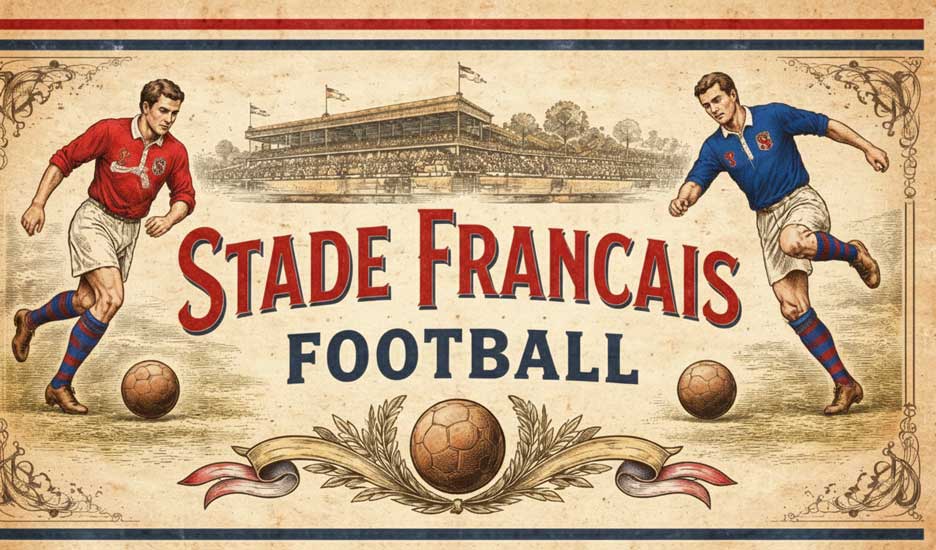
Founded in 1900, Stade Français football was the French champion in 1928 and a major player in Parisian football before the PSG era.
Between 1946 and 1967, the club played in the first division, facing prestigious teams such as Porto, Sevilla, and Juventus, with legendary players like Larbi Ben Barek.
After a gradual decline linked to losing the Parc des Princes and the rise of PSG, the club now focuses on amateur football and youth development.
Table of Contents
When people think of Stade Français, the mind almost instinctively goes to rugby: a legendary club, national titles, Jean-Bouin, and today a stadium shared with Paris FC. Yet here, we are talking not about Stade Français’ rugby legacy, but its football section, now largely forgotten.
Yes, Stade Français was also a football club, a French champion, and a major figure in pre-war Parisian football. It played several seasons at the Parc des Princes long before PSG existed. A unique and little-known story that deserves to be told—tracing the journey of a pioneering club, long erased from collective memory, but influential in the early days of French football.
The golden age in the first division
Stade Français is a French football club founded in 1900, part of the multi-sport club based in Paris’ 16th arrondissement.
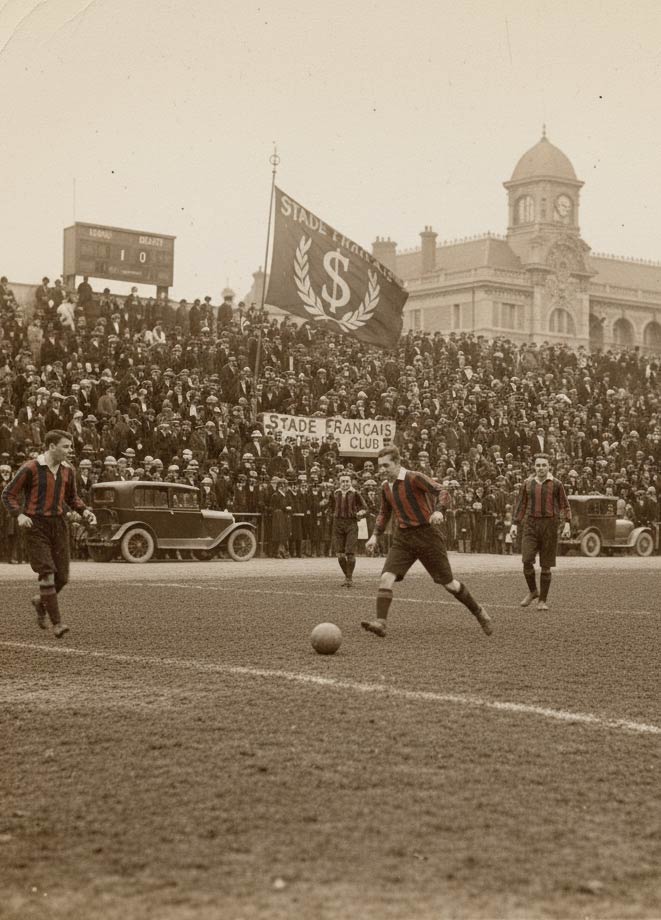
In 1928, Stade Français already made its mark nationally by becoming French champion. This title, however, should be seen in context: at the time, the championship was not yet a unified professional competition but an amateur system that pitted the best clubs from different regional leagues against each other. Nonetheless, this achievement reflected the club’s sporting significance in interwar French football.
It is also hard to imagine today that the football section of Stade Français was a regular presence in France’s top tier for nearly two decades. Between 1946 and 1967, the club played fifteen seasons in the first division (Division Nationale), establishing itself as a stronghold of Parisian football well before the birth of Paris Saint-Germain.
A journey in European competition…
Stade Français also participated in European competitions between 1964 and 1966, through the legendary Inter-Cities Fairs Cup, appearing several times. While never a top contender, the club faced prestigious opponents such as FC Porto, Real Betis, and Juventus.
This era featured legendary players. The most striking example is Larbi Ben Barek, a French international with 17 caps. Later nicknamed “The Foot of God,” he joined the club in 1945 and stayed three years. His transfer to Atlético Madrid for 17 million francs was a record at the time.
When Stade Français played at Parc des Princes and sought its future
During this period, Stade Français hosted opponents at the historic Parc des Princes, then shared with Racing Club de Paris (Racing CFF), long before the stadium’s major renovation in 1972.
The club also experienced several merger attempts, notably with Cercle Athlétique de Paris between 1942 and 1944. Later, despite the failed merger project with Red Star between 1948 and 1950 that would have created Stade Français–Red Star, the club won the Division 2 title in 1952.
Stade Français football: a club that fell into obscurity
What happened next? The decline of Stade Français football was due to multiple factors. The creation of Paris Saint-Germain captured the Parisian audience and financial resources, relegating historic clubs to the sidelines. Unlike rugby, which adapted to professionalism and built a strong identity with its pink jerseys, the football section remained part of the amateur multi-sport association, lacking brand appeal or visibility.
This fall was not due to a dramatic event—no financial crisis, bankruptcy, or scandal—but a slow erosion of status, similar to many historic clubs unable to adapt to professionalization and modern football economics. The club faded quietly. Today, most Parisians associate Stade Français with rugby, and its football section has become a forgotten relic.
Present-day D5 football in Hauts-de-Seine
After its peak in the 1940s‑1960s, Stade Français football gradually declined from the 1970s onward, with multiple relegations taking it from national divisions to regional leagues. Stade Français no longer plays at Parc des Princes, whose 1972 renovation led Paris FC to temporarily occupy it, before PSG became the emblematic resident in 1974, dominating Parisian football.
Professional status ended in 1985, and the senior team disappeared in 1987, marking the club’s definitive shift to amateur football. In the 1990s and 2000s, the club settled at Haras Lupin sports center in Vaucresson, focusing on local football in the Hauts-de-Seine departmental leagues, with no national ambitions.
A renewal began in 2009 under new leadership: the senior section was relaunched, the club invested in youth development and local engagement. Today, Stade Français remains an amateur club, focused on training and community involvement, with around 300 youngsters in its FFF-certified football school, with no short-term plans to return to professional football.
Frequently Asked Questions
Is Stade Français a multi-sport club?
Yes. Founded in the late 19th century, it is one of France’s oldest multi-sport clubs. It has over 20 sports sections, including athletics, swimming, tennis, golf, basketball, squash, football, and rugby. The club has exceptional private facilities, notably at Faisanderie (Saint-Cloud) and Haras Lupin (Vaucresson), supporting both recreational and competitive sports.
Is Stade Français football part of the same club as Stade Français rugby?
Legally and historically, yes. Structurally, however, there is a distinction. The professional rugby section is run by a SASP to compete in the Top 14, while the football section is part of the amateur multi-sport association. Although they share traditional colors, their budgets and management are separate.
Where does Stade Français football play?
Unlike the rugby team, which plays at Stade Jean-Bouin in Paris, the football section is based in the western suburbs. Training and home matches mainly take place at Haras Lupin in Vaucresson (Hauts-de-Seine), the club’s historical heart.
Why did this club decline so much?
The decline resulted from economic and sporting factors. After abandoning professional status in the late 1960s, the club could not keep up with financial inflation. Losing Parc des Princes and the rise of PSG drained sponsors and audiences, relegating historic clubs like Stade Français and Racing to amateur levels.

Johann Macq
Web writer passionate about football and history, I have specialized for several years in clubs from Paris and the Île-de-France region. I cover both the most well-known teams and those with a more understated prestige, sharing stories, anecdotes, and insights with fellow football enthusiasts.