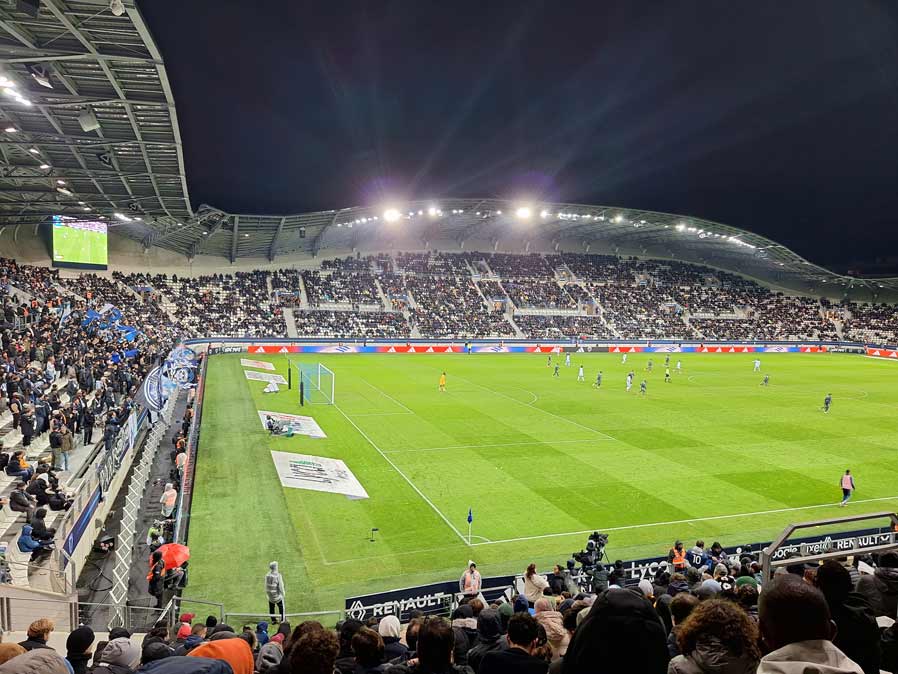



Key Facts
- Location and accessibility: located at 20-40 Avenue du Général Sarrail (16th arrondissement), just a few meters from Parc des Princes, Jean Bouin is easily accessible by metro, bus, bike, or car, with mobility solutions and nearby parking.
- Modern and versatile stadium: rebuilt from 2010 to 2013, it offers nearly 20,000 seats, VIP boxes, media areas, and a hybrid pitch suitable for both rugby and football.
- Successful cohabitation: hosting both Stade Français and Paris FC, the stadium demonstrates effective sharing of urban sports infrastructure between two professional clubs.
Table of Contents
About Stade Jean Bouin
Located in Paris’s 16th arrondissement, Stade Jean Bouin now stands as the modern home of Paris FC. Traditionally dedicated to rugby, it is the home ground of Stade Français, its historic resident. However, Jean Bouin is no stranger to football, having hosted Versailles FC in the National league for several seasons.
Neighboring the iconic Parc des Princes, just a few meters away, this state-of-the-art facility provides Paris FC with a fully redesigned setting for its home games. Completely rebuilt and inaugurated in 2013, the stadium is striking for its unique concrete lattice exterior, designed by architect Rudy Ricciotti. Unlike the former Charléty stadium, often criticized for the distance of its stands, Jean Bouin offers far superior comfort for spectators.
Fans are close to the action! With 19,904 seats, the stadium is not XXL-sized but provides high-end amenities: VIP boxes, next-generation media areas, and an ultra-modern hybrid pitch. For Paris FC, playing here represents a significant upgrade compared to Charléty and its athletics track.
Accessibility of Stade Jean Bouin in Paris
Stade Jean Bouin is located at 20-40 Avenue du Général Sarrail, 75016 Paris. The stadium literally neighbors Parc des Princes, making the PSG-PFC derby probably one of the closest in the world between two venues.
The stadium is well-served by public transport and offers multiple options for matchdays or events. It is close to several metro stations and bus stops, and provides accessibility solutions for people with reduced mobility, as well as nearby public parking.
| How to access | Practical Details |
|---|---|
| 📍 Address | 20‑40 Avenue du Général Sarrail, 75016 Paris |
| 🚇 Metro | Line 9 – Porte de Saint‑Cloud / Exelmans / Michel‑Ange Molitor Line 10 – Porte d’Auteuil / Boulogne Billancourt |
| 🚌 Bus | Lines 22, 62, 72 (Porte de Saint‑Cloud) and 32, 52 (Porte d’Auteuil) |
| 🚲 Bike / Vélib’ | Vélib’ stations nearby; bike parking at the corner of Avenue du Général Sarrail and Rue Méryon |
| 🚗 Car | Access via Porte d’Auteuil exit (North or South Périphérique); public parking around the stadium (Porte de Saint‑Cloud / Parc des Princes / Boulogne) |
| 🦽 Accessibility (Persons with Reduced Mobility) | PRM parking at the bottom of Rue du Commandant Guilbaud (via Rue du Parc); special access on request by email to the ticket office for additional facilities |
History and Secrets of Stade Jean Bouin
The Jean Bouin story began in 1925. At that time, the venue was modest, far from the architectural gem it is today. For decades, it served as a training and competition ground for various sports, living in the shadow of its imposing neighbor, Parc des Princes.
The real turning point came in the early 2010s. The City of Paris, owner of the stadium, launched a complete reconstruction project to provide Stade Français, the historic resident club, with a venue worthy of its ambitions.
The Jean Bouin Revolution
The construction ran from 2010 to 2013, with an investment of €160 million (original source in french). A technical feat by Rudy Ricciotti, Grand National Architecture Prize winner in 2006. His concept? A spectacular asymmetrical lattice made of 3,500 Ultra-High Performance Fiber-Reinforced Concrete panels (UHPC). This lattice not only dazzles with its play of light and shadow but also ensures optimal natural ventilation and acoustic protection for the surrounding residential area.
The transformation went far beyond appearance. The stadium meets strict environmental standards:
- 2,800 m² of photovoltaic panels cover the roof
- Rainwater recovery system for pitch maintenance
- High-performance thermal insulation drastically reducing energy consumption
This modernization increased capacity from 12,000 to nearly 20,000 seats, while integrating commercial spaces and offices. The result: a lively venue all year round, not just on matchdays.
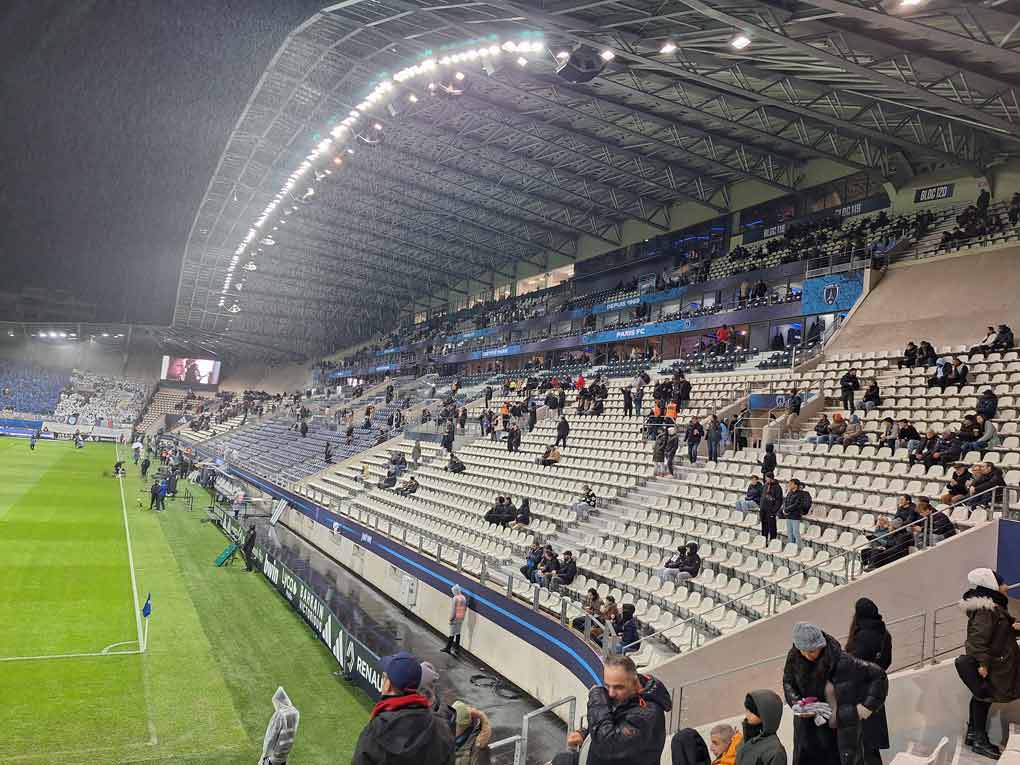
A Versatile Stadium That Makes a Difference
The real strength of the new Jean Bouin? Its exceptional versatility. Designed for rugby, it has proven remarkably flexible in hosting other major events, especially football: the stadium regularly hosts the Paris Sevens tournament (part of the world rugby sevens circuit), PSG women’s team matches, and now Paris FC games.
Due to unavailability of their own stadiums, Versailles FC (2022-2025) and Red Star (2016-2017) also played at Jean Bouin.
Unique Cohabitation with Stade Français
The arrival of Paris FC at Jean Bouin created a unique logistical cohabitation with Stade Français, the historic resident. This situation is rare in France, where stadiums usually belong to a single primary club.
The main challenge? Coordinated scheduling. Top 14 rugby and Ligue 1 football follow different rhythms, and matches can fall on the same weekend. Meticulous coordination is required between the National Rugby League, Professional Football League, and stadium managers to avoid clashes.
Transitioning between rugby and football configurations demands precision: new line markings, goalpost changes (rugby to football), and above all, pitch restoration.
Rugby especially wears down the turf (scrums, rucks), so Jean Bouin opted for a hybrid pitch, combining natural grass and synthetic fibers, to provide a surface that is both durable and high-performing.
🚧 Les travaux ont débuté cette semaine à Jean Bouin.
— Stade Français Paris (@SFParisRugby) July 4, 2025
Une nouvelle pelouse hybride sera posée pour le début de saison !#SFParis 🌸⚡️ pic.twitter.com/QaeIrY3XuK
Stade Charléty: Looking Back at Paris FC’s Former Home
Before moving to the modern Jean Bouin, Paris FC called Stade Charléty home for many years. This iconic southern Paris venue shaped a significant part of the club’s identity.
Located in the 13th arrondissement, between Boulevard Kellermann and the périphérique, Charléty witnessed Paris FC’s ups and downs over many seasons. Inaugurated in 1994 in its current form (though sporting activities had been hosted since 1939), it accompanied the club through its National league years and stabilization in Ligue 2.
For long-time fans, Charléty evokes mixed memories. It was here that the club fought for survival, built promotion projects, and experienced tense playoff matches. The stadium also saw record attendances during “free entry” operations, sometimes exceeding 15,000 spectators. However, Charléty was often perceived as a “cold” stadium, struggling to retain fan fervor due to its open architectural configuration.
Features and Facilities of Stade Charléty
Charléty remains primarily a multi-sport complex, designed for both athletics and team sports.
The presence of an athletics track is the main difference with Jean Bouin. While it allows hosting international meetings like the Meeting de Paris, it creates a significant distance between players and spectators.
TOUS AU STADE !
— Paris FC Community (@ParisFCommunity) September 13, 2024
J-1 avant le retour à Charléty 💙🏟
Paris FC - Metz, 14h30, et c'est GRATUIT !
Venez nombreux ! pic.twitter.com/oMKYnIcESg
Why Did Paris FC Change Stadiums?
Charléty was simply not designed for football: fan capacity was limited, atmosphere was hard to create, and proximity to the pitch was nearly impossible due to the athletics track and the airflow between distant stands.
To support its growth and professionalization under the Arnaud family, Paris FC needed a venue capable of generating emotion and conducive to football. Choosing Jean Bouin fulfilled this ambition: a modern stadium, well-located in the 16th arrondissement and easily accessible by metro, enhancing the spectator experience, strengthening the club’s brand image, and offering superior facilities (boxes, lounges) compared to Charléty.
Impact of the Move and Future Prospects
The move to Jean Bouin and Paris FC’s promotion to Ligue 1 created a positive shockwave among supporters, who increasingly attend matches.
This renewal comes with a reimagined marketing dynamic. The club can now sell a true “matchday experience”, including on-field spectacle and improved ancillary services (catering, shops) integrated into Jean Bouin
Conclusion: Paris FC’s Anchoring in Its New Home
By moving to Stade Jean Bouin, Paris FC did more than change addresses. It changed status. Moving from a worn-out Charléty, unsuitable for modern football, to a high-tech, vibrant arena, the club equipped itself for its ambitions.
At Jean Bouin, Paris FC can begin writing its new chapter.
Frequently Asked Questions
Why did Paris FC change stadiums?
Paris FC left Charléty mainly due to recurrent and critical pitch deterioration, which made professional football difficult and unsafe. Jean Bouin also offers a better atmosphere and closer proximity to fans thanks to the absence of an athletics track.
What is the difference between Paris Saint-Germain and Paris FC?
Paris Saint-Germain (PSG) and Paris FC (PFC) are two distinct clubs: PSG, founded in 1970, plays in Ligue 1 at Parc des Princes, while Paris FC, formed from a PSG split in 1972, is a club with no major national titles yet.
Johann Macq
Web writer passionate about football and history, I have specialized for several years in clubs from Paris and the Île-de-France region. I cover both the most well-known teams and those with a more understated prestige, sharing stories, anecdotes, and insights with fellow football enthusiasts.