




Table of contents
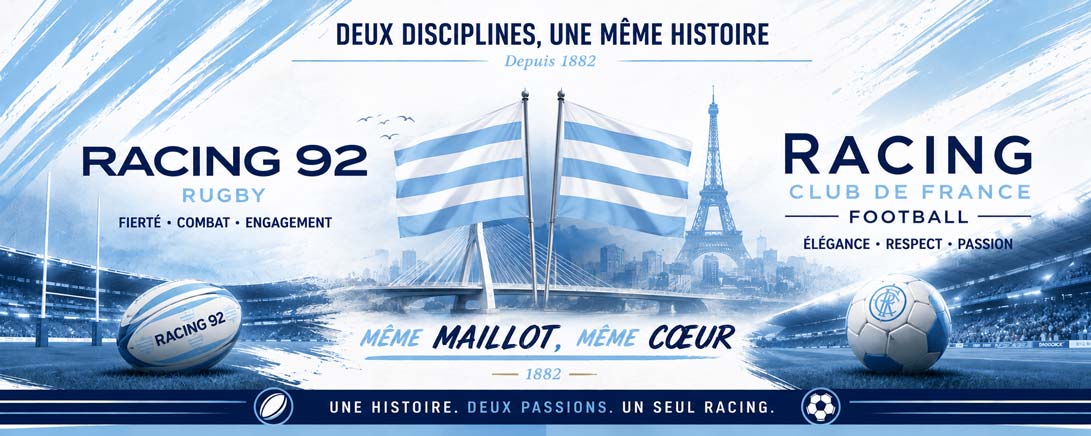
Still at the rumor stage, the idea of a rapprochement between Racing 92 and Racing Club de France Football nevertheless seems more than logical.
Historically linked within the legendary Racing Club de France, the two clubs now operate under separate legal structures.
On one side, Racing 92, a giant of French rugby firmly established among Europe’s elite. On the other, Racing Club de France Football, a historic institution of French football that has been stuck in the amateur divisions for many years. Two different trajectories, but a shared history… and perhaps a shared future.
Here is why a merger — or at least a strong partnership — would make sense.

1) A shared return to Stade Yves-du-Manoir
This is probably the strongest symbol.
With the announced sale of Paris La Défense Arena by Jacky Lorenzetti to an American group, Racing 92 needed to find a new long-term solution for its future. The rugby club ultimately secured a 50-year temporary occupation agreement to return to the legendary Stade Yves-du-Manoir, which is currently being renovated.
Meanwhile, since the redevelopment of the Olympic site, Racing Club de France Football has also found itself without a true permanent home ground. The club has spent several seasons playing between Versailles and Poissy, far from its historic roots.
Seeing both clubs coexist once again in the iconic home of Racing Club de France would carry enormous symbolic significance. The two clubs are reportedly already in discussions on the matter.
2) A shared history within Racing Club de France
Before legal separations and modern restructurings, rugby and football belonged to the same institution: the Racing Club de France multi-sport organization.
For decades, the two sections shared a common identity, facilities, and sporting culture inherited from one of France’s most prestigious clubs. A reunification would therefore not be an artificial creation, but rather a return to the club’s roots.
3) The same colors, the same identity
Sky blue and white.
Both Racing 92 and Racing Club de France Football still wear the historic colors of Racing Club de France today — a strong visual identity instantly recognizable in the French sporting landscape.
At a time when many clubs are desperately searching for history and identity, Racing already possesses that heritage. Reuniting it would give even greater coherence to the Racing brand.
4) A multi-sport club could create genuine popular enthusiasm
Today, neither Racing 92 nor Racing Club de France Football enjoys a popular fan base comparable to France’s biggest clubs.
A merger of forces could change that.
The example of Olympiacos in Greece is often cited: the popularity of its basketball section is deeply connected to that of its football team. The same logic applies to FC Barcelona and Real Madrid CF with their multi-sport structures.
A modern Racing multi-sport club could help build a strong overall identity and attract a new generation of supporters under a common banner.
5) Football in the Paris region still has huge potential
Paris and the Île-de-France region remain paradoxically underrepresented in French professional football considering their population size and economic power.
In the long term, the region could easily support five or six top-flight clubs, much like London does in the Premier League.
From that perspective, Racing Club de France Football represents enormous potential: history, location, premium image, and a massive population base.
Racing 92 would arguably benefit more from supporting that growth than from remaining isolated within rugby alone.
6) “Racing Club de France” — a far stronger historic brand than “Racing 92”
Over the decades, both clubs have changed names several times.
The football section recently chose to return to its historic identity by officially reclaiming the name Racing Club de France Football — a move praised by many observers.
Racing 92 could follow the same path.
Because “Racing 92” remains a relatively recent name, strongly tied to a territorial branding strategy centered around the Hauts-de-Seine department and Paris La Défense Arena. With the announced return to Stade Yves-du-Manoir, that geographic branding becomes less relevant.
The timing therefore seems ideal to bring back the historic name: Racing Club de France.
A name filled with history, prestige, and immediate recognition.
7) Racing 92’s youth teams already use that name
Interestingly, Racing 92’s youth teams have kept the “Racing Club de France” designation.
As if, deep down, the club’s historic DNA had never completely disappeared.
This detail shows that the Racing Club de France brand still carries genuine symbolic value internally. A possible merger would ultimately only formalize a cultural reality that has existed for a long time.
A crazy idea… but ultimately a logical one?
Today, nothing officially suggests that a merger is being prepared. But the points of convergence are numerous: a return to Colombes, shared history, shared visual identity, and strategic complementarity.
In a French sporting landscape undergoing major transformation, where historic brands are seeking to reinvent themselves, the return of a great multi-sport Racing Club de France would make sense.
And perhaps even have a certain elegance.
Johann Macq
Web writer passionate about football and history, I have specialized for several years in clubs from Paris and the Île-de-France region. I cover both the most well-known teams and those with a more understated prestige, sharing stories, anecdotes, and insights with fellow football enthusiasts.